
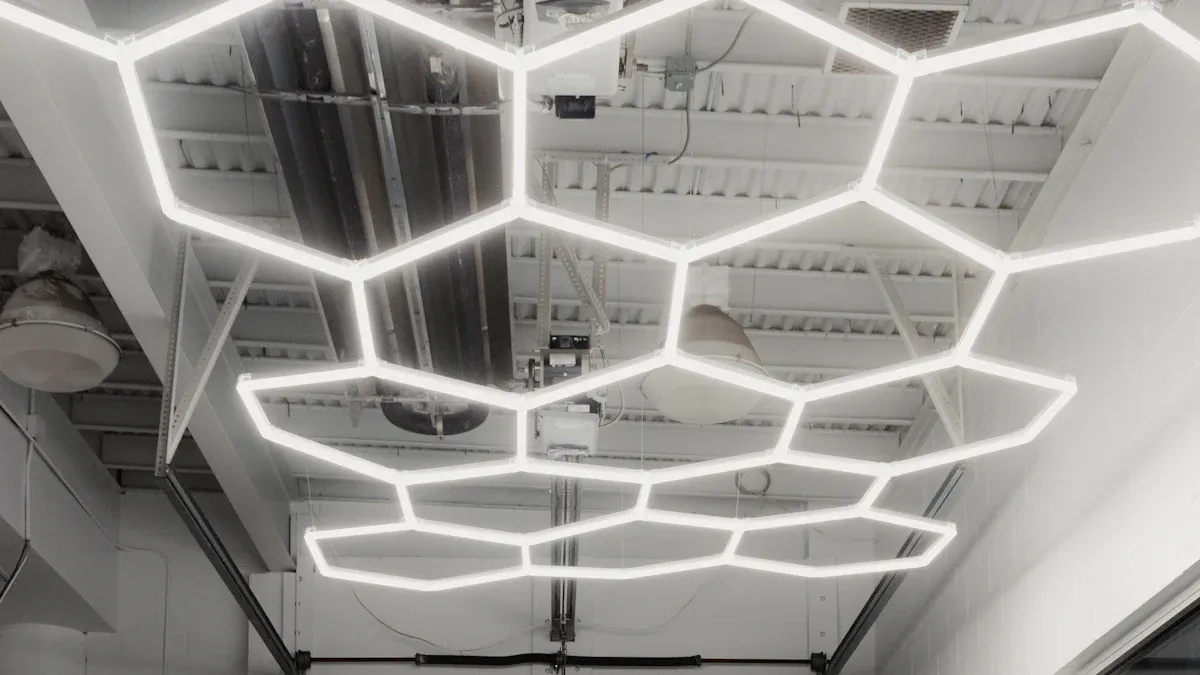
When you look for the best garage lighting ideas, focus on energy-efficient solutions that save money and improve your workspace. Today, LED lighting stands out because it uses up to 80% less energy than traditional bulbs. LEDs last over 25,000 hours, so you replace them less often. Consider these popular options:
LED ceiling lights for broad, even coverage
LED strip lights for flexible placement and modern style
LED work lights for portable, focused tasks
LED flood lights for bright, secure spaces
LED task lights for precision work
Upgrade old fixtures, choose the right bulbs, and add smart controls to get the most out of your garage lighting.
Key Takeaways
Switch to LED lights to save up to 80% on energy costs and enjoy longer-lasting bulbs.
Use smart controls like motion sensors and timers to maximize energy efficiency and reduce waste.
Plan your garage lighting layout carefully to ensure even coverage and avoid dark spots.
Choose the right color temperature (4000K to 5000K) for better visibility and comfort in your garage.
Regularly maintain your lighting system to ensure optimal performance and safety.
Why Energy-Efficient Garage Lighting Matters
Energy-efficient garage lighting is not only about reducing electricity costs. It also affects visibility, safety, and the quality of work performed in the space.
According to the U.S. Department of Energy, LED lighting products typically provide significantly longer lifespans than traditional lighting technologies, with many quality LED products rated for 30,000–50,000 hours of useful life.
For garages used as workshops, lighting quality is especially important. Beyond brightness, factors such as CRI (Color Rendering Index), glare control, and light distribution influence how accurately users can see colors, tools, and small details.
The Illuminating Engineering Society (IES) also recommends layered lighting layouts in garages and workshops to improve visibility and reduce harsh shadows during detailed tasks.
Cost Savings and Environmental Benefits
You can transform your garage by choosing energy-efficient lighting. When you switch to LED bulbs, you lower your electricity bills because LEDs use much less energy than traditional incandescent bulbs. Incandescent bulbs waste most of their energy as heat, but LEDs convert more electricity into light. This means you get energy efficiency that saves money every month. LEDs also last longer, so you spend less on replacements and maintenance.
How Much Can LED Garage Lighting Save?
The actual savings depend on electricity rates, usage time, and fixture efficiency.
A simple calculation:
Annual Energy Cost = Wattage × Hours Used × Electricity Rate
Example: Replacing a 60W incandescent bulb with a 12W LED bulb:
Incandescent: 60W × 4 hours/day × 365 days = 87.6 kWh/year
LED: 12W × 4 hours/day × 365 days = 17.5 kWh/year
The LED option uses approximately 80% less electricity while producing similar brightness.
Energy-efficient garage lighting offers important environmental benefits.
You reduce energy consumption, which lowers demand on power plants.
You help decrease greenhouse gas emissions by using less energy from fossil fuels.
You create less material waste because LEDs last longer than traditional bulbs.
Solar-powered lighting uses renewable energy from sunlight, cutting your dependence on grid power and supporting sustainable energy solutions.
Upgrading your garage lighting aligns with global sustainability goals. Smart technology lets you monitor and adjust your lighting in real time, making sure you use energy only when needed. These practices set a positive example for energy efficiency throughout your home.
Safety and Performance Improvements
Better garage lighting ideas improve safety and performance for you and your family.
Enhanced visibility helps you avoid accidents in cluttered spaces.
Motion sensor lights deter burglars and intruders, increasing security.
A well-lit garage makes it easier to organize and find tools or items.
You can maximize energy savings by using LED lights, installing LED panels for even coverage, and choosing high bay LEDs for garages with tall ceilings. Motion sensors and dimmers adjust brightness based on usage, and smart lighting solutions allow remote control and scheduling. These strategies ensure your garage lighting works efficiently and keeps your space safe.
Energy-Efficient Lighting Types
Choosing the right types of garage lights can make a big difference in your energy use and the quality of your workspace. You have several options, but some stand out for their efficiency, brightness, and durability. Let’s look at the main choices for garage lighting.
The most common garage lighting options include:
LED garage lights
LED shop lights
CFL lighting
Halogen lighting
Incandescent lighting
Among these options, LED lighting provides the best overall performance because it combines high efficiency, long lifespan, and flexible installation options.
LED Garage Lights
You will find that led garage lights offer the best combination of brightness, energy savings, and long lifespan. These lights use advanced technology to deliver more light with less power. You can see the difference in the numbers:
Bulb Type |
Average Lifespan (hours) |
|
LED |
80 - 100 |
15,000 - 25,000 |
CFL |
~60 |
10,000 |
Halogen |
16~24 |
2,000 |
Incandescent |
10~17 |
1,000 |
You get more light for every watt you use with led garage lights. You also change bulbs less often because they last much longer than other types. Here’s why these lights are the most efficient and durable choice for your garage:
You get superior brightness with lower wattage. This means you see better without using extra energy.
You enjoy instant-on performance with no flickering, even in cold garages.
You save money on your energy bills because these lights use much less electricity.
You replace bulbs less often, thanks to their long lifespan.
You can pick from many designs, including the best led shop lights for wide coverage or focused task lighting for workbenches.
Many homeowners now choose led garage lights as the foundation of their garage lighting ideas. You can also find smart versions that let you control your lights from your phone or set schedules for even more savings.
Tip: For most garages, the best led shop lights provide bright, even light and are easy to install. You can mount them on ceilings or walls to cover large areas.
CFL and Other Options
Compact fluorescent lamps (CFLs) offer better energy efficiency than old incandescent bulbs. You can use CFLs to cut your energy use by up to 75% compared to traditional bulbs. They last longer, too—usually between 7,000 and 15,000 hours. This means you do not need to change them as often.
While CFLs use less electricity than traditional bulbs, they do contain a small amount of mercury.
Because of this mercury content, CFLs require careful handling and special recycling procedures if they break or burn out to protect the environment.
You save money on energy bills, but not as much as with led garage lights.
LED bulbs last longer and use even less energy than CFLs.
You may notice that frequent switching does not shorten the life of CFLs enough to outweigh the energy savings. Experts recommend turning off your garage lights when you leave the room.
Halogen and Incandescent Comparison
Halogen and incandescent bulbs are older options for garage lighting. You may see them in some garages, but they do not match the efficiency of newer lights.
A 60-watt incandescent bulb costs about $4.80 to run each year. A 12-watt LED bulb costs only $1.00 for the same time.
Halogen bulbs provide bright, white light. However, their efficiency is only marginally better than standard incandescents and still falls far behind modern LED lights.
Both halogen and incandescent bulbs have short lifespans. You will need to replace them often, which adds to your costs and waste.
If you want the most efficient garage lighting, you should avoid halogen and incandescent bulbs. Instead, focus on led garage lights or the best led shop lights for your main fixtures.
Note: Recent advances in garage lighting include smart controls and solar-powered options. You can now use solar energy to power your lights at night, which lowers your energy bills and helps the environment.
When you plan your garage lighting ideas, always consider energy use, brightness, and how often you want to change bulbs. Led garage lights give you the best results for most garages.
Garage Lighting Ideas and Planning
Assessing Your Garage Space
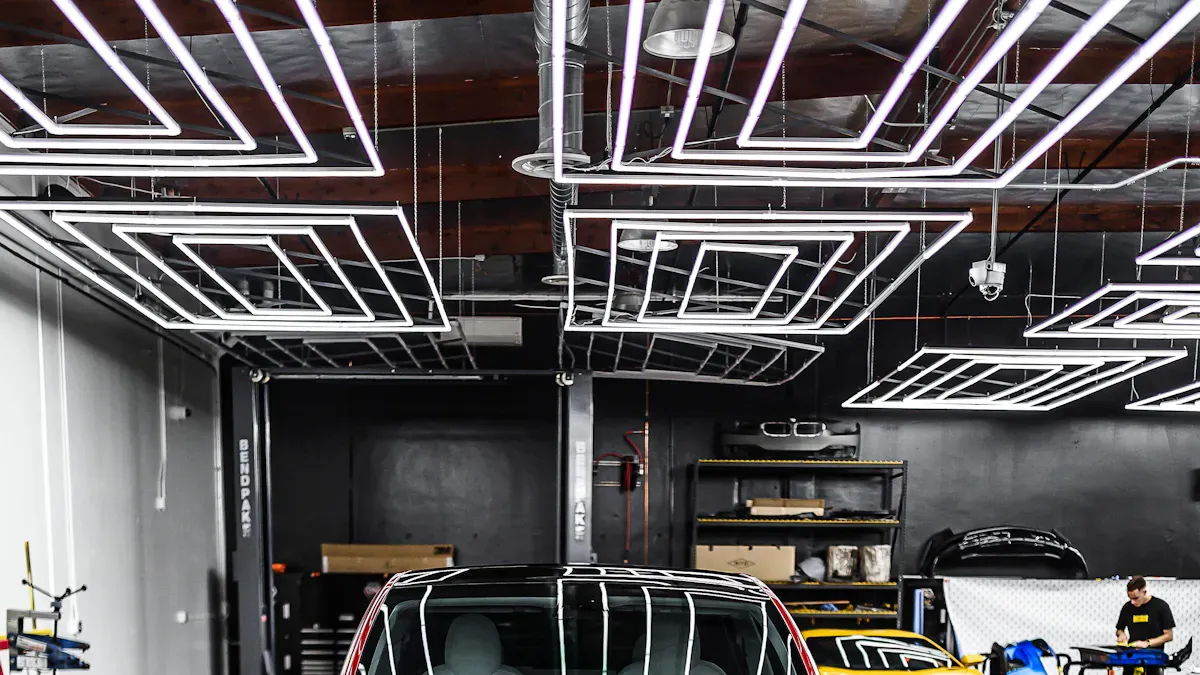
In many home garage renovation projects, homeowners discover that a single ceiling fixture often leaves dark corners and shadows near storage shelves or workbenches. Installing multiple LED garage lights across the ceiling usually creates more balanced illumination and improves visibility for parking, tool organization, and repair work.
For garages used as workshops, many installers also recommend combining overhead LED fixtures with task lighting above workbenches to reduce eye strain during detailed projects.
Start by looking at your garage layout and thinking about how you use the space. You want to avoid dark corners and shadows. To get the best lighting, follow these steps:
Space overhead lights evenly across the ceiling. This helps prevent shadows and gives you even coverage.
Use a mix of overhead, task lighting, and accent lights. Overhead lights brighten the whole area, while task lighting focuses on workbenches or tool stations.
Mount fixtures at the right height, usually between 8 and 12 feet. This height spreads light well and avoids glare.
Add dimmers or smart switches. These controls let you adjust brightness and save energy.
Tip: Plan your garage lighting ideas before you buy fixtures. This helps you avoid buying too many or too few lights.
Calculating Fixtures and Brightness
You need the right number of fixtures and the right brightness for your garage. Here are some tips to help you decide:
Measure your garage. Multiply the length by the width to get the total square footage.
Aim for 50 to 75 lumens per square foot. For example, a 300-square-foot garage needs 15,000 to 22,500 lumens.
Think about what you do in your garage. If you work on cars or crafts, you need brighter lights.
Check your ceiling height. High ceilings may need more fixtures or higher wattage bulbs.
Choosing the best lighting for your garage means matching the light level to your needs. You want enough light for safety and comfort.
Brightness should be evaluated by lumens rather than watts. ENERGY STAR explains that lumens measure the amount of visible light produced, while wattage indicates energy consumption.
Choosing Color Temperature
Pick a color temperature that helps you see clearly. For most garages, lights between 4000K and 5000K work best. This range looks like daylight and makes it easier to see details. If you do detailed work, use lights at 5000K or higher. This bright, cool light improves contrast and helps you spot small parts or read labels.
When you plan your garage lighting, think about how each choice affects visibility, comfort, and energy use. Good planning leads to a brighter, safer, and more efficient garage.
Smart Controls for Garage Lighting
Motion Sensors and Timers
You can make your garage lighting much more efficient by adding motion sensors and timers. These smart controls help you save energy and money. When you use motion sensors, your lights turn on only when they detect movement. This means you never waste energy lighting an empty garage. Timers let you set specific times for your lights to turn on and off. You avoid leaving lights on by accident. If you combine both features, you get even better results. Your lights will only stay on when you need them and turn off automatically when you leave.
Motion sensors activate lights only when movement is detected, which minimizes energy waste from unnecessary lighting.
Timers enable you to set specific on and off times based on actual usage, preventing lights from being left on unnecessarily.
Combining timers with motion sensors can further enhance energy efficiency by ensuring lights are only on when truly needed.
Many homeowners choose motion sensor lighting for garages because it is simple to install and very effective.
Photo Sensors and Dimmers
Photo sensors and dimmers add another layer of control to your garage lighting. Photo sensors measure the amount of natural light in your garage. When sunlight is bright, these sensors keep your lights off. As it gets darker, the lights turn on automatically. Dimmers let you adjust the brightness to match your needs. You can lower the light for simple tasks or increase it for detailed work. Both features help you use only as much energy as you need.
Integrating with Home Automation
You can connect your garage lighting to a home automation system for even more control. With smart home integration, you manage your lights from your smartphone or voice assistant. You can set schedules, create scenes, and adjust settings from anywhere. Advanced systems use environmental sensors to detect natural light, motion, and occupancy. The system can dim or turn off lights when no one is present or when sunlight fills the garage. This setup makes your garage lighting more responsive and efficient.
Tip: Upgrade older fixtures to work with smart controls. Modern LED fixtures often support smart features, making your garage lighting system more flexible and energy efficient.
Common Garage Lighting Mistakes to Avoid
Many homeowners focus only on brightness when choosing garage lighting, but improper fixture placement and color temperature can reduce visibility and create uncomfortable glare. Avoid these common garage lighting mistakes:
Using a Single Ceiling Fixture
One central fixture often creates shadows around vehicles, shelves, and work areas. Multiple LED garage lights provide more even illumination.
Choosing the Wrong Color Temperature
Warm 2700K lighting may feel too dim for garages and workshops. Most experts recommend 4000K to 5000K lighting for better visibility and contrast.
Ignoring Task Lighting
Overhead lighting alone is usually not enough for workbenches or repair stations. Dedicated task lighting improves precision and reduces eye strain.
Installing Excessively Bright Fixtures
Overlighting can create glare on polished tools, vehicles, and concrete floors. Balanced lighting layouts produce better comfort and visibility.
Installation Tips and Common Mistakes
DIY vs. Professional Setup
You can choose to install garage lighting yourself or hire a professional. Each option has benefits and drawbacks. Review the table below to help decide which approach fits your needs:
Advantages of DIY |
Disadvantages of DIY |
Saves money |
May lack expertise for complex tasks |
More control over the project |
Potential safety risks |
Suitable for simple tasks |
Time-consuming for larger projects |
Advantages of Professional Installation |
Disadvantages of Professional Installation |
Expertise ensures quality and safety |
Higher costs |
Saves time for complex installations |
Less control over the process |
Can handle complex tasks like electrical work |
Dependence on the contractor's schedule |
Tip: You can easily install smart bulbs or plug-in motion sensors yourself. For hardwired smart switches or complex wiring, consider hiring a licensed electrician.
Fixture Placement
Proper fixture placement improves safety and visibility in your garage. You should avoid relying on a single overhead light. Layer different types of lighting for consistent illumination and fewer shadows.
Use general, task, and ambient lighting to cover all areas.
Consider using fixtures with diffusers to illuminate higher areas, or slightly angle your lights to wash the walls.
Choose fixtures with the right beam angle and diffuser to soften shadows.
Paint ceilings and walls with light colors to scatter light.
Note: Multiple light sources help you see better and reduce dark spots.
Avoiding Overlighting and Underlighting
You want balanced lighting in your garage. Too much light causes discomfort, while too little makes tasks difficult. Follow these guidelines to achieve the right brightness:
Guideline |
Description |
Ceiling Height |
Match fixture type to ceiling height for comfort and adequate lighting. |
Fixture Type |
Use UFO high bay lights for tall ceilings, linear fixtures for lower ceilings. |
Lumen Output |
Plan based on lumens, not wattage, for proper brightness. |
Beam Angle |
Select fixtures with suitable beam angles for even light distribution. |
Fixture Spacing |
Space fixtures evenly to avoid dark spots and ensure uniform coverage. |
Tip: Replace fixtures older than 10 years. Older lights often flicker, need frequent bulb changes, and provide less brightness. Upgrading improves energy efficiency and performance.
Regular maintenance keeps your lighting system working well. Clean fixtures every few months. Check sensors and connections. Monitor brightness and replace bulbs when needed.
Installation tips help you avoid common mistakes and create a safer, brighter garage.
When you upgrade your garage, you gain many benefits. The table below shows how energy-efficient garage lighting ideas help you:
Benefit |
Description |
Reduced Energy Consumption |
Energy-efficient lighting uses less electricity, lowering utility bills. |
Longer Lifespan |
LED and CFL bulbs last significantly longer than traditional bulbs. |
Improved Durability |
These lighting options are more robust and less prone to breakage. |
Better Light Quality |
Provides brighter and more consistent lighting, enhancing visibility. |
Enhanced Safety and Visibility |
A well-lit garage improves safety, making it easier to navigate the space. |
You get the best lighting by choosing the right bulbs, fixtures, and smart controls. LEDs last longer and use less energy. Smart controls let you manage lights from anywhere. If you want to make the switch, start with a lighting assessment and plan for flexibility. You will see how LED lighting enhances garage safety and saves money. Take action now for a brighter, safer, and more efficient garage.
FAQ
What is the best type of light for a garage?
You should choose LED lights for your garage. LEDs use less energy, last longer, and give bright, even light. They work well in cold temperatures and need little maintenance.
How many lumens do I need for a two-car garage?
You need about 20,000 to 30,000 lumens for a standard two-car garage (typically 400-500 square feet) to meet the recommended 50 to 75 lumens per square foot. If you only need basic ambient lighting for parking, 8,000 to 12,000 lumens might suffice, but for tool benches and detailed tasks, stick to the higher range. Measure your space and adjust the number of fixtures as needed.
Can I install smart controls on existing garage lights?
You can add smart controls to many modern fixtures. Replace old fixtures if they do not support smart switches or sensors. Smart controls help you save energy and add convenience.
What are the main garage lighting options?
You can pick from LED, fluorescent, and CFL lights. LEDs give the best efficiency and lifespan. Fluorescent and CFL bulbs use less energy than incandescent bulbs but do not last as long as LEDs.
How do I avoid glare in my garage lighting?
You should use diffusers or frosted covers on your fixtures. Place lights at the right height and angle. Paint walls and ceilings with light colors to help scatter light and reduce glare.
Share:
Expert Tips for Lighting Rooms with Lamps
How to Install a Ceiling Fan Without Existing Wiring: My Complete Guide